Lifeskills & Citizenship
Assistant Principal (Pastoral Curriculum): Miss J Coe
Email: coej@hattonacademy.org.uk
Director of Sixth Form (Key Stage 5 Lead): Miss A Williams
Email: williamsa@hattonacademy.org.uk
The Lifeskills (PSHE) and Citizenship curriculum at Sir Christopher Hatton Academy is a coherent and carefully sequenced programme designed to equip students with the knowledge, skills and understanding needed to thrive in modern Britain and beyond.
Our curriculum goes beyond statutory requirements, combining Relationships and Sex Education (RSE) and Health Education with key themes linked to character development, careers education and preparation for adult life.
Learning is structured to reflect the needs of our students and community, ensuring that content is both relevant and responsive to real-world issues. Students revisit key themes throughout their time at the academy, allowing them to build confidence, deepen understanding and apply their learning in different contexts.
There are several core threads that run throughout the programme, including:
- Health and wellbeing, including mental health and emotional resilience
- Relationships, including respect, consent and healthy boundaries
- Staying safe, including well-beingg online safety, risk and safeguarding
- Financial education and preparation for the world of work
- Citizenship, including democracy, equality and British Values
These themes are reinforced through a range of approaches, including tutor-led sessions, discussion, real-life scenarios and opportunities to reflect. The curriculum is closely linked to our wider personal development provision, including Hatton Character Qualities, Careers Education and Student Leadership (Flourishing Leaders), ensuring a joined-up and meaningful experience for all students.
Relationships and Sex Education (RSE), along with Health Education, forms a statutory part of the curriculum, and further information can be found in our RSE Policy.
The curriculum is reviewed regularly to ensure it reflects emerging local and national priorities and continues to meet the needs of our students.
Key Stage 3
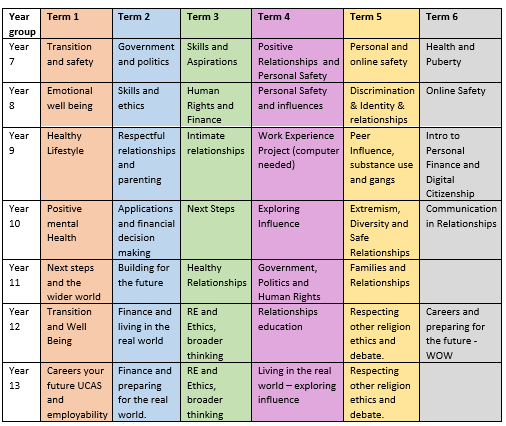
In Key Stage 3, students are introduced to the core themes of Lifeskills, with a strong focus on personal wellbeing, identity, safety and understanding the wider world.
In Year 7, the curriculum supports transition into secondary school, with a focus on mental health, emotional regulation, personal safety and healthy relationships. Students also explore key areas such as online safety, peer relationships, and managing risk, including early education around substances and harmful behaviours.
In Year 8, students build on this foundation by exploring influences on behaviour and decision-making, including the role of social media, peer pressure and financial awareness. Students are introduced to topics such as money management, ethical decision-making and careers, helping them to understand how their choices impact their future.
By Year 9, learning becomes increasingly contextualised and real-world focused, with students exploring more complex and sensitive topics such as:
- Peer influence and pressure
- Risk-taking behaviours (including drugs, gangs and exploitation)
- Healthy and unhealthy relationships, including consent
- Online safety, including grooming and digital footprint
- Financial decision-making, including budgeting, gambling and fraud
Students also begin to make clearer links between their learning and future pathways, including careers and life beyond school.
Key Stage 4
At Key Stage 4, the curriculum builds on prior learning and focuses on preparing students for adult life, further education and employment.
In Year 10, students explore a wide range of topics linked to health, relationships and future planning, including:
- Managing physical and mental health, including anxiety, sleep and lifestyle choices
- Relationships education, including consent, online relationships, exploitation and abuse
- Financial education, including borrowing, financial products, consumer rights and managing money
- Careers preparation, including CV writing, interview skills, labour market information and workplace expectations
Students also engage with complex real-world issues, such as body image, media influence, discrimination and equality, ensuring they are able to critically evaluate the world around them.
In Year 11, the curriculum supports students as they approach key transition points, with a focus on independent living, future pathways and personal wellbeing. Topics include:
- Careers and post-16 pathways
- Financial independence, including budgeting and employment contracts
- Managing stress, resilience and mental health during exam periods
- Citizenship and society, including democracy, government and individual responsibility
This ensures that students leave Key Stage 4 with the knowledge and confidence Key Stage 5
In Year 12 and 13 a programme of Citizenship and Personal, Social and Health Education takes place which is tailored to meet the various needs of the students as they move towards Higher Education or employment with training. This also includes aspects of preparing for independent living; a range of external speakers delivering input on topics such as driver safety; Citizenship units. Students are prepared for University, Apprenticeships and other career opportunities. There is a focus on mental and physical wellbeing and preparing them for life in 'Modern Democratic Britain'. Students also work towards completing specific tasks as part of their personal development log to ensure that when they leave us our students are well-rounded and respectful individuals who are ready for the wider world and the work place.
Form Time and Lifeskills
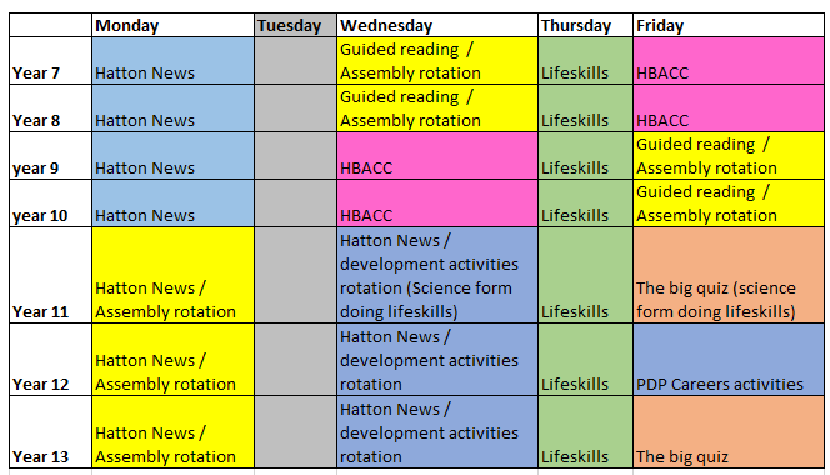
Weekly Plan
We follow a week A and B Rotation to ensure that all year groups have centralised bi-weekly assembly.
Lifeskills Topics by Term